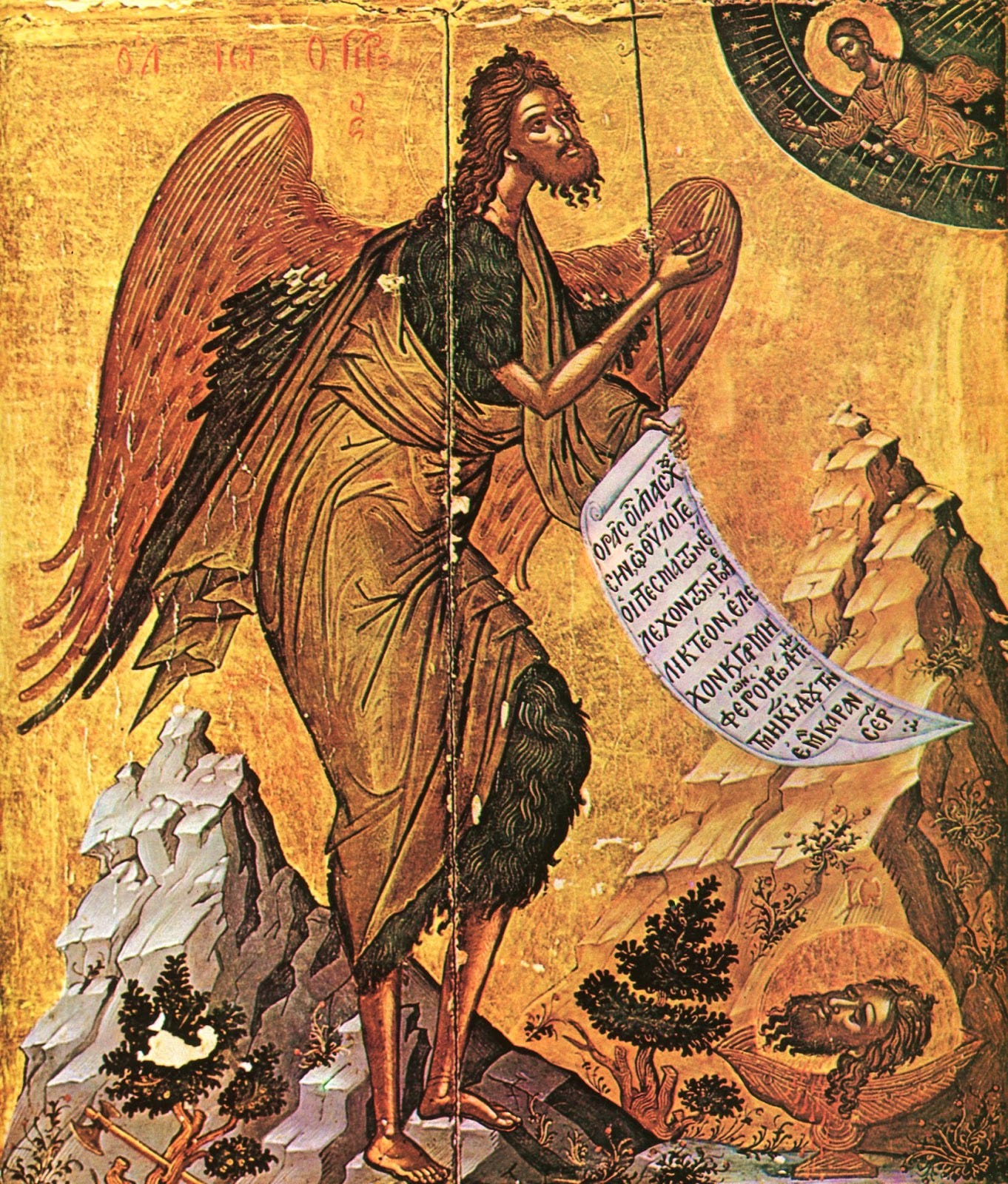
At Vespers in the Orthodox Church on the eve of the Beheading of St. John the Forerunner, we hear verses from Malachi, which speak of the terrible and great Day of the Lord:
“But who can endure the day of His coming? And who can stand when He appears? For He is like a refiner’s fire and like launderers’ soap. He will sit as a refiner and a purifier of silver; He will purify the sons of Levi, and purge them as gold and silver, that they may offer to the Lord an offering in righteousness” (Malachi 3:2-3).
Then, in the last verse of the last chapter of Malachi we hear,
“Behold, I will send you Elijah the prophet before the coming of the great and dreadful day of the Lord. And he will turn the hearts of the fathers to the children, and the hearts of the children to their fathers, lest I come and strike the earth with a curse” (4:5-6).
Malachi is the last book in the last section (the Scroll of the Twelve) of the second part of Scripture, known as the Prophets. In these last verses of Malachi, both Moses and Elijah are mentioned. In the Gospels, John the Baptist functions in the role of Elijah. When Jesus’ disciples ask him, as they are coming down from the mountain where they saw him transfigured before them and speaking with Moses and Elijah, “why do scribes say that Elijah must come first?” he tells them, “Elijah is coming first to restore all things. And I tell you that Elijah has already come and they did to him whatever they wished. Likewise, the Son of Man will suffer at their hands.” And then, in the narrative, Matthew makes it clear what Jesus is saying: “Then his disciples understood that he spoke to them of John the Baptist” (Matthew 17:13). Jesus is teaching his disciples that his suffering is the reference point, a mere prelude to his coming again as judge. In the Gospels, Jesus’ suffering and his return in glory are closely connected; they are treated as practically one reality of which John the Baptist functions as the forerunner. In another place in Matthew, Jesus says, “for those who are willing to accept it, [John the Baptist] is the Elijah who is to come” (Matthew 11:14).
In both Matthew and Mark, John is associated with Elijah in the passage of the Transfiguration. Although that association is not made in Luke’s account, he connects the Forerunner to Elijah in a different, more subtle way. Luke is the only one of the four Gospels with an infancy narrative of John. In Luke, we learn that John’s father’s name was Zachariah (1:5). In the Scroll of the Twelve, the last of the so-called Latter Prophets, the penultimate book is Zachariah. In the Prophets, then, after Zachariah comes Malachi, in whose last verses mention is made of the terrible and great Day of the Lord, before which he will send Elijah, “who will turn the hearts of the fathers to the children, and the hearts of the children to their fathers, lest I come and strike the earth with a curse” (4:5-6). It is hard to imagine this as mere coincidence. Luke would have clearly had the sequence of the Latter Prophets in mind when communicating to his hearers Zachariah as the name of the Forerunner’s father.
John in the role of Elijah - The point of this teaching is the urgency of the message of repentance. John is the last prophet before the coming of the Messiah and his message prepares us for the great and terrible Day of the Lord. One can never reason that since Elijah hasn’t come yet, there is still plenty of time. In the gospel narrative, Jesus is the eschatological Christ, the messiah of the end times. After he is crucified, raised up and seated at the right hand of God in power, the next act on the program is his return in glory as Judge. In the hymnography of the Church, it is Elijah who is called “the forerunner of the Second Coming of Christ.” In the Gospels, that role is filled by John the Baptist.
This is essentially why John is referred to as “the greatest born of a woman” - he is the greatest and last prophet before the coming of the Lord. At Vespers in the eve of John’s feast days, we hear that repeated as a refrain in the stichera at “Lord, I Have Cried,” and it is taken from the Gospels, where Jesus says “of those born of woman, none is greater than John the Baptist” (Matthew 11:11 a). John’s position on the iconostasis in the Church is on the left of the icon of Christ, indicating he is the last - the greatest - figure under the Old Covenant. He prepares the way of the Lord by preaching the same message as the Messiah preaches, repeated verbatim in Matthew (“Repent for the kingdom of heaven is at hand”) but ahead of him. And since Christ is the eschatological Messiah, after John comes the Great and Terrible Day of the Lord.
Another aspect of calling John “the greatest born of a woman” is that it makes a distinction between the old and new covenants. The expression “born of woman” in the Old Testament is used in parallel with “man” meaning “a human”: “Man who is born of woman is of few days and full of trouble” (Job 14:1). In Christ, children of God are born, “not of flesh, or of blood or the will of man, but of God” (John 1:11-12). That is why after calling John the greatest born of a woman, Jesus says that “he who is least in the kingdom of heaven is greater than John” (Matthew 11:11 b). Surely, even those who are in Christ, who have received him (John 1:12) - that is to say, who have submitted to the Gospel of which he is the content - emerged out of the womb of their mother. But their status as children of God and heirs of his promise is based on something else.
“Most assuredly, I say to you, unless one is born of water and the Spirit, he cannot enter the kingdom of God. That which is born of the flesh is flesh, and that which is born of the Spirit is spirit” (John 3:5-6).
“And because you are sons, God has sent forth the Spirit of His Son into your hearts, crying out, ‘Abba, Father!’” (Galatians 4:6).
Thus, even the least among the children of the kingdom is greater than the greatest born of a woman.
A Light to the Nations on YouTube.