The Next Generation.

In Scripture, the mercy of God is expressed in his extending life to the next generation. We hear this demonstrated in two parallel stories in the Gospel of Mark: one in the raising of Jairus’ daughter in chapter 5, and the other in the healing of the man’s son with a mute spirit in chapter 9. In both of these, the terminology found later when Paul speaks of Jesus being raised from the dead, and then standing in that raised position, appear in the same sequence.
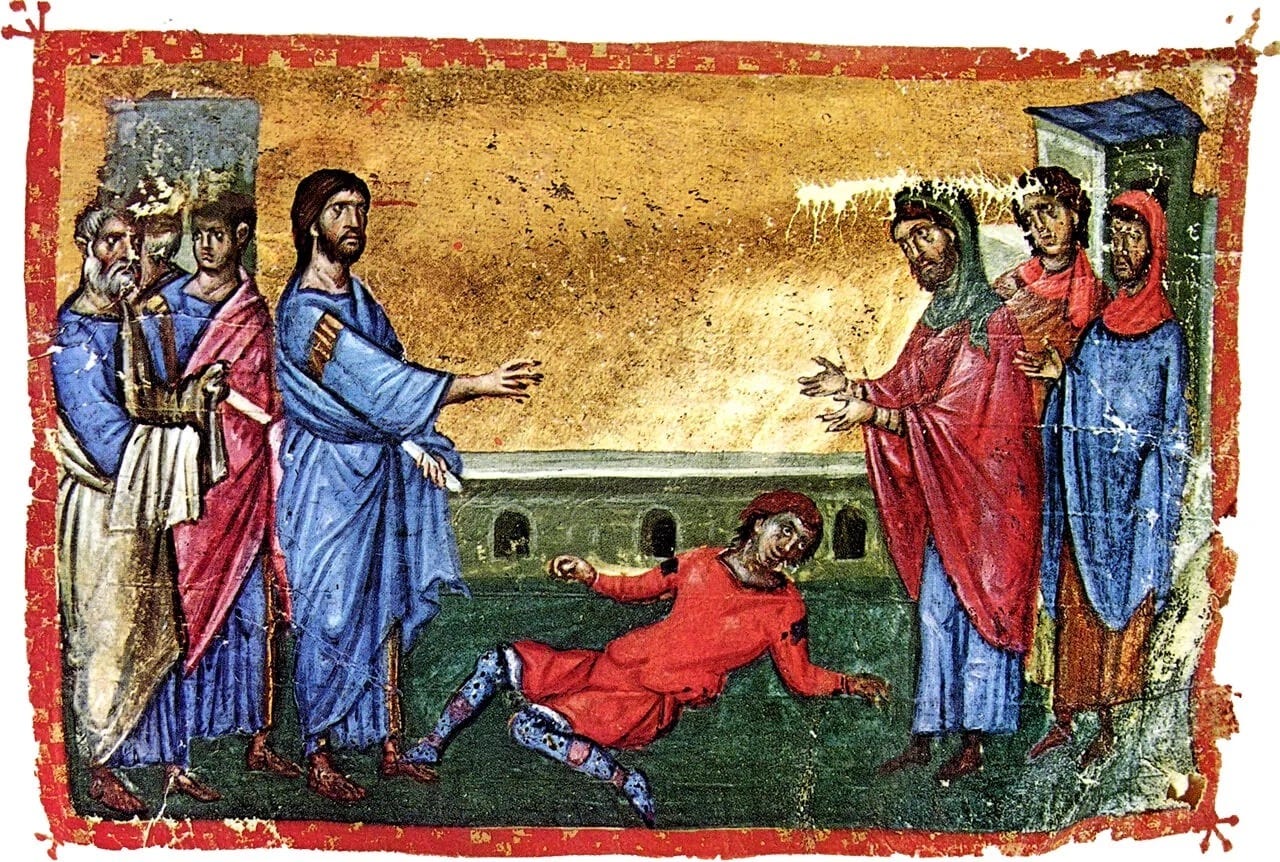
Let’s hear the passage from Mark chapter 5 about Jairus’ daughter:
35While He was still speaking, some came from the ruler of the synagogue’s house who said, “Your daughter is dead. Why trouble the Teacher any further?” 36As soon as Jesus heard the word that was spoken, He said to the ruler of the synagogue, “Do not be afraid; only believe.”37And He permitted no one to follow Him except Peter, James, and John the brother of James. 38Then He came to the house of the ruler of the synagogue, and saw a tumult and those who wept and wailed loudly. 39When He came in, He said to them, “Why make this commotion and weep? The child is not dead, but sleeping.” 40And they ridiculed Him. But when He had put them all outside, He took the father and the mother of the child, and those who were with Him, and entered where the child was lying. 41Then He took the child by the hand, and said to her, “Talitha, cumi,” which is translated, “Little girl, I say to you, arise.”42Immediately the girl arose and walked, for she was twelve years of age. And they were overcome with great amazement. 43But He commanded them strictly that no one should know it, and said that something should be given her to eat.
In verse 41, the phrase that is rendered in both Aramaic and Greek - ἔγειρε (egeire) - uses the verb ἐγείρω in the imperative: “Arise!” In the verse that follows, we hear that immediately she arose and walked. That verb is ἀνέστη (anestē) from ἀνίστημι which means to be standing upright. There are things to note here. First, the use of both Aramaic and Greek in this passage functions to address the hearers of the gospel, and Jesus’ three disciples, Peter, James and John, who are associated with the leadership in Jerusalem, along with the parents of the girl. This underscores that the gospel message applies to both Jews and Greeks alike. Second, the text tells us that the girl immediately arose and walked. In the Bible, the verb to walk - περιπατέω (peripateó) - is technical terminology. It refers to following a certain path, which is the way of the gospel. Moreover, although the two verbs in verses 41 and 42 sound similar in English, they function differently in the original Greek. The first one is ἐγείρω (egeiró), often a transitive verb, meaning it takes a direct object, and its meaning is to lift or raise up something. The second verb, ἀνίστημι (anistémi), means to be in the standing position. It is what results from the action of the first verb: Jesus commands her to be lifted up, ἔγειρε, and consequently, she is said to be in the standing position, ἀνέστη.
These same two verbs are used in the same sequence in another passage from Mark chapter 9. Let’s hear verses 25-27:
25When Jesus saw that the people came running together, He rebuked the unclean spirit, saying to it, “Deaf and dumb spirit, I command you, come out of him and enter him no more!” 26Then the spirit cried out, convulsed him greatly, and came out of him. And he became as one dead, so that many said, “He is dead.” 27But Jesus took him by the hand and lifted him up, and he arose.
Like the daughter of Jairus, the boy here appears to be dead. And that is emphasized by the repetition in verse 26: “many said he is dead.” This parallels the repetition we heard in chapter 5, first in the announcement made to Jairus that he shouldn’t trouble the teacher any longer because his daughter is dead, and then in the refuting of that claim by Jesus, who says that she is only sleeping. And then in verse 27, we hear Jesus that took him by the hand and lifted him up, ἤγειρεν, and he arose, ἀνέστη.
Notice how in both of these stories, we have a person who has thought to be dead, and who is then to be raised up, ἔγειρε, and finally in the standing position, that is, ἀνέστη. These are the same two terms that are used in the letters of Paul to speak of the resurrection of Jesus from the dead. In chapter 1 of Galatians, we hear:
1Paul, an apostle not from men nor through man, but through Jesus Christ and God the Father who raised Him from the dead (ἐγείραντος from ἐγείρω).
And in 1 Thessalonians 4:
14For if we believe that Jesus died and rose again, even so God will bring with Him those who sleep in Jesus. Here the verb is ἀνέστη.
The first verb is an action by God, who raises up Jesus. Notice it is a transitive verb where God is the agent/subject and Jesus is the direct object, the one being raised. The second verb, ἀνίστημι, refers to being or standing upright. It can be transitive or in transitive. In these instances it describes the outcome of someone or something having been raised up.
Mark’s use of these two verbs is intelligent. He is introducing, already in chapter 5, the word that will be used by Jesus in chapters 8, 9 and 10 in the three predictions of his passion, and in chapter 16, by the young man to announce that Jesus is not in the tomb but is risen. And he employs the terminology of Paul, who teaches that it was God who raised Jesus from the dead. As a result of that action, Jesus is in the standing position. He is ἀνέστη. In the two passages from chapter 5, and chapter 9, however, it is Jesus who raises someone, lifts them up - ἐγείρω; and as a result of that action, both of them are said to be standing - ἀνέστη. Mark’s use of the two verbs, in that specific sequence, reflects the teaching that, just as God raises Jesus from the dead, he gives him the power to raise the dead for judgment:
26For as the Father has life in Himself, so He has granted the Son to have life in Himself, 27and has given Him authority to execute judgment also,because He is the Son of Man. 28Do not marvel at this; for the hour is coming in which all who are in the graves will hear His voice29and come forth—those who have done good, to the resurrection of life, and those who have done evil, to the resurrection of condemnation (John 5:26-29).
The most impressive aspect of the two passages from the Gospel of Mark is that they depict the healing of children. In chapter 5, it is not Jairus, the ruler of the synagogue, with the need, but rather his 12-year-old daughter. In chapter 9, it is not the man from the crowd with a mute spirit, but rather his son, who is said to have been afflicted from childhood. We find this also in chapter 7, where a Syro-Phoenician woman pleads on behalf of her daughter (vv. 24-30). The emphasis on progeny demonstrates how Scripture is offering another chance, and is thus an expression of God’s mercy. As a word of instruction, this second (“latest”) chance offers life not only to the hearers, but also to the following generations. This mechanism is at its clearest in the story of the children of Israel entering Canaan. Although the Lord had brought them out of Egypt and instructed them on Mount Sinai, none of the ones who left Egypt entered Canaan (Joshua 5:4). That is why Joshua circumcises them upon entering the land and repeats the words of the Law to them (8:30-35). The Law, which had been intended to give life, did not do that because of the stubbornness and rebellion on the part of the people. In the New Testament, the Apostle Paul recounts for the Corinthians how their fathers crossed the Red Sea and were led in the wilderness, and were even fed by God, yet they were struck down by him. And he concludes that, although these things happened to their fathers, they were written down as a warning to them, the addressees of his letter, whom he positions at the end of the ages (1 Corinthians 10:1-11). This is precisely God’s touch of grace - providing, in the telling and re-telling of the story, instruction for his children, a grace extended to the hearers of Scripture in every generation.
A Light To The Nations on YouTube
A Light To The Nations podcast
Photo by Luis Quintero: https://www.pexels.com/photo/photo-of-person-holding-a-bible-2294873/